


Keeping cannabis use private can leave your doctor without information that matters to your care. Knowing how to talk to your doctor about medical cannabis starts with sharing whether you use it, which symptoms you hope to manage, and how often you use it. This helps your doctor consider possible medication interactions and understand your health history.
It’s understandable to feel unsure about raising the topic, especially if you’re concerned about being judged or aren’t sure how medical cannabis fits with your current treatment. An open conversation gives you and your doctor a chance to discuss your concerns, past treatments, and potential risks together.
This article explains why it’s important to tell your doctor about cannabis use, how eligibility and certification work in New Jersey, and how a primary care physician can be part of the discussion. You’ll also learn what information can help make the conversation clear and useful.
Key Takeaways
- Tell your doctor about cannabis use, symptoms, and treatments you’ve tried so they can consider the full picture of your care.
- Learn what to bring to a cannabis conversation, including your medication list and relevant medical records.
- Understand how New Jersey certification and eligibility relate to a doctor’s assessment and recommendation.
- Consider how primary care can support an informed discussion about cannabis alongside your broader health needs.
What are the benefits of telling your doctor if you’re taking medical marijuana?
Sharing cannabis use gives your doctor information to consider alongside your symptoms, health history, and medicines. A primary care physician who knows your history can be a helpful starting point for an open discussion.
Reviewing Previous Treatments and Side Effects
When reviewing past treatments, describe what you tried, what helped, and any side effects. This gives your doctor context for discussing options without overstating symptoms. Bring a medicine list and specific examples, such as a treatment that eased chronic pain but caused unwanted effects. Include therapies you stopped and why. These details connect your treatment history with your current concerns.
Sharing Cannabis Use With Your Doctor
Explain whether you use marijuana, why you use it, and how you take it. Be specific about the symptoms you hope to manage, such as pain or anxiety, and how they affect daily life. If you already use cannabis, share when you began, how often you use it, the amount, and the method. Medical cannabis may be smoked, vaporized, or taken as oral tablets, and these forms differ in how they are used. Ask a doctor who is comfortable discussing cannabis to address your questions. Federal law prevents doctors from prescribing cannabis, but they may discuss and recommend it.
CBD Safety and Interactions
Discuss cannabidiol (CBD) use alongside your other medicines and health conditions. Tell your doctor about CBD products, including how much you take and how often, because CBD can interact with other medications. Share your full medicine list, including nonprescription drugs. THC and CBD amounts vary by product and formulation, so ask your doctor how to read the product label and discuss an appropriate approach. General guidance is to start with a low dose and increase it slowly, while tracking effects and discussing concerns with your doctor.
Medical cannabis certification and state requirements
New Jersey’s medical cannabis program has state eligibility and certification rules. A clinician assesses your health information and whether certification may be appropriate for your circumstances.
Eligibility and Qualifying Conditions
Eligibility means meeting the state program’s criteria and receiving a clinician’s assessment for certification. Symptoms alone don’t establish that someone qualifies. Medical cannabis rules differ by state, so qualifying conditions elsewhere may not apply in New Jersey. Clearly describe your diagnosis, symptoms, and treatment history during the assessment. Ask how the clinician evaluates your records and which state criteria relate to your condition.
People may seek medical cannabis for reasons including chronic pain, PTSD, and epilepsy, but these examples aren’t a list of New Jersey eligibility criteria. A health assessment or tests may help a clinician determine whether someone is a candidate. Certification is a recommendation, not a guarantee of approval or a cannabis prescription. The state program’s criteria and the clinician’s assessment shape the decision.
State Access Rules and Cannabis Laws
State access rules explain how an eligible patient applies, receives certification, and registers with a medical cannabis program. State approval doesn’t change federal law: cannabis remains illegal under federal law, and doctors cannot prescribe it. They may recommend it through state programs. A recommendation is different from a prescription.
In New Jersey, follow the state program’s application and registration process after discussing certification with a clinician. Review the required forms and documentation, and make sure information about your condition is consistent across your records and application. Don’t assume another state’s process applies. State rules determine access, while federal law remains separate. Cannabis products may also interact with medicines, so include your current prescriptions in the discussion.
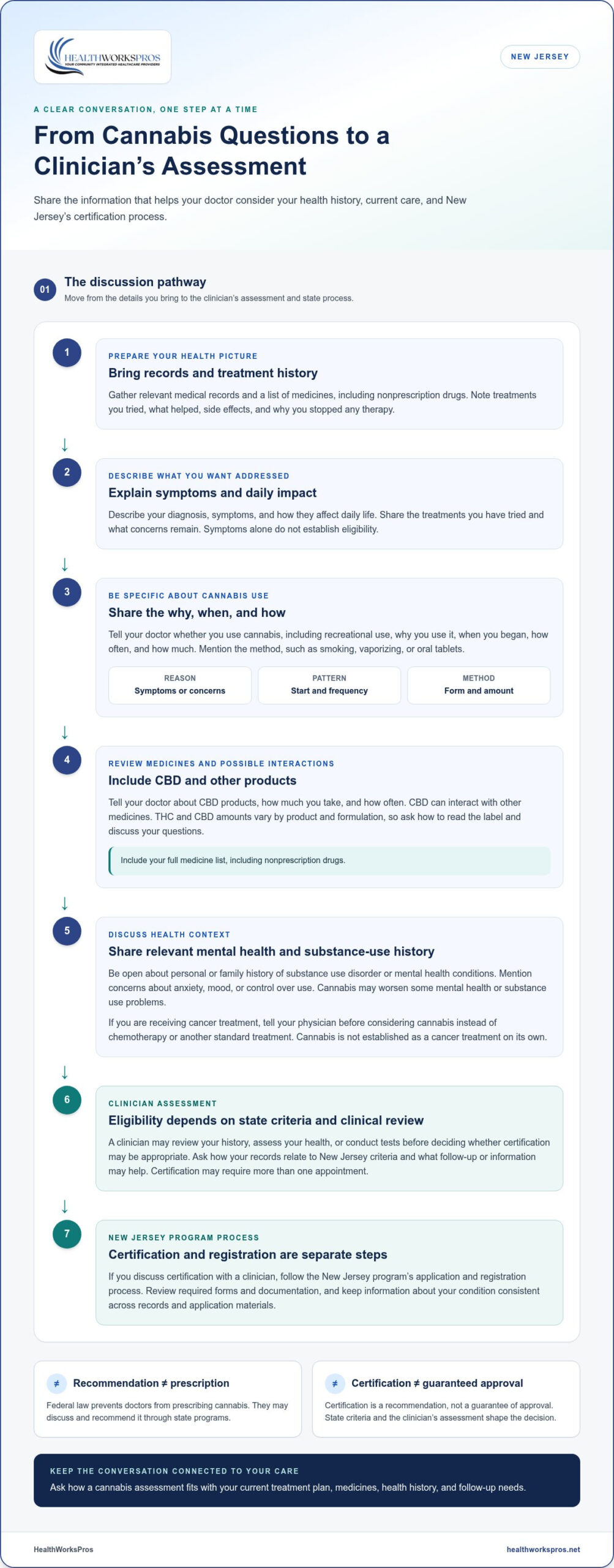
Medical cannabis eligibility and talking with a primary care physician
Your primary care physician can help place medical cannabis questions in the context of your health history. That conversation can connect eligibility concerns with current care, mental health, and other treatment goals.
Bring relevant medical records and a clear account of the condition you want addressed. A physician may review your history, assess your health, or conduct tests before deciding whether you may be a candidate. Certification may require more than one appointment, so use the first conversation to ask what information or follow-up would help. Discuss how your current care plan fits with a medical cannabis assessment.
Be open about any personal or family history of substance use disorder or mental health conditions. Cannabis may worsen some mental health or substance use problems, so this context helps physicians weigh potential risks. Mention recreational use as well as medical use, since your reasons for using cannabis can shape the discussion. Describe any concerns about anxiety, mood, or control over use without minimizing them.
If you’re receiving cancer treatment, tell your physician before considering cannabis instead of chemotherapy or another standard treatment. Cannabis isn’t established as a cancer treatment on its own. Physicians can’t prescribe cannabis, but they may make recommendations within state programs. A recommendation and government registration are distinct steps. Ask what evidence informs the recommendation, how it fits your care, and what follow-up matters. Medical cannabis isn’t right for every patient; eligibility depends on state criteria and clinical assessment.
Discuss your medical cannabis questions
HealthWorksPros: Primary Health Care
HealthWorksPros offers Primary Health Care and a Medical Cannabis Program for patients seeking support with health questions and treatment discussions. Primary care can help you review your medical history, current medicines, and symptoms as you consider whether to explore cannabis certification. A conversation about medical cannabis can also clarify questions about your care and next steps, without assuming it’s right for everyone.
If chronic pain is one of your concerns, acupuncture for chronic pain management may also be relevant to discuss as part of your care. Share what you hope to address and which treatments you’ve tried so your care team understands your priorities.
Contact HealthWorksPros to discuss your care.
Take the Next Step in Your Care
Learning how to talk to your doctor about medical cannabis can open a thoughtful conversation about your health priorities. Bring your questions, explain what matters in daily life, and work with your healthcare team to consider appropriate next steps. Your care may include different kinds of support: HealthWorksPros offers Primary Health Care, Acupuncture for Chronic Pain Management, and SHIELD™ Workforce Health & Occupational Medicine.
Let your concerns guide the discussion. A respectful conversation can help you feel prepared to make informed decisions with your healthcare provider.
Taking the first step can be as simple as sharing what you hope to address.
Frequently Asked Questions
Should I talk to my doctor about cannabis?
Yes. Tell your doctor about medical or recreational cannabis use, since it may matter during care beyond a cannabis evaluation. For example, tell an anesthesiologist whether your use is occasional or daily and how much you use, as this information could affect the anesthetic plan. Share any changes in your use with your healthcare team, too.
Can you get a medical marijuana card for anxiety?
Eligibility depends on New Jersey program criteria and a clinician’s assessment. Describe the anxiety symptoms you experience, how they affect daily activities, and any care you’ve received. Ask how your health information relates to the program’s criteria and which records may help assess your situation. An assessment considers more than one symptom or label.
How should I start the conversation with my doctors?
A helpful way to talk to your doctor about medical cannabis is to begin with your care goal: “I’d like to discuss whether cannabis could fit into my treatment plan.” Then explain what you use it for, if applicable, and invite questions about safety or alternatives. If you feel nervous, bring a trusted friend or family member for support.
Is medical marijuana helpful and safe?
Medical marijuana may help with some symptoms, such as pain, nausea, or low appetite, but it isn’t suitable for everyone. Safety depends partly on your health and other medicines. For example, cannabis may raise bleeding concerns for people taking blood thinners. If you’re pregnant or breastfeeding, discuss use with your doctor because it may affect a baby’s development.
Should you take medical marijuana instead of or along with conventional therapy?
Discuss cannabis alongside your existing care before changing or replacing a treatment. Cannabis may help manage symptoms, but it shouldn’t be treated as a stand-alone cancer therapy. If you’re receiving chemotherapy or another cancer treatment, tell your doctor about cannabis use or plans to use it. Your care team can consider your overall treatment plan and potential interactions.

Article by
HealthWorksPros Clinical Editorial Team
This article was reviewed by the HealthWorksPros clinical and healthcare communications team. HealthWorksPros (HWP) is an integrated healthcare organization providing evidence-based primary care, behavioral health, psychiatry, counseling, occupational medicine, telehealth, and substance use treatment to individuals, families, employers, and communities throughout Northern New Jersey. Our content is created to educate and inform and is reviewed for medical accuracy using current clinical standards and trusted healthcare resources. While our articles provide general health information, they are not a substitute for personalized medical advice, diagnosis, or treatment. If you have questions about your health or need medical care, schedule an appointment with one of our healthcare providers.
Disclaimer
The information provided on this website is for general educational and informational purposes only and is not intended as medical advice, diagnosis, or treatment. Content is reviewed for accuracy at the time of publication but should not be considered a substitute for professional medical evaluation or personalized healthcare recommendations.
Always seek the advice of your physician or another qualified healthcare provider regarding any medical condition or before starting, stopping, or changing any treatment. Never disregard professional medical advice or delay seeking care because of information you have read on this website.
If you believe you are experiencing a medical emergency, call 911 or go to the nearest emergency department immediately.
Use of this website does not establish a physician-patient relationship with HealthWorksPros (HWP) or any of its providers. Appointment requests or communications submitted through this website do not guarantee the establishment of a provider-patient relationship until you have been evaluated and accepted for care in accordance with applicable laws and professional standards.