


Could your metabolic health be more than a number on the scale? It reflects how your body manages energy and includes measures such as blood sugar, blood pressure, blood fats, and waist size. Weight may be one part of the picture, but it cannot explain everything on its own. If medical terms or test results feel confusing, you are not alone.
This guide explains metabolic health in plain language and how it differs from metabolic syndrome, a cluster of risk factors. You will learn how to prepare a useful health snapshot, including available results, medicines, and questions, before speaking with a clinician. You will also see how next steps may be tailored to your needs, from everyday habits to further evaluation or treatment options. The goal is not to draw a conclusion from one number, but to start a clearer, more informed conversation about your health.
Key Takeaways
- Metabolic health involves more than body weight. Clinicians consider health measures alongside your history and symptoms.
- Gather available test results and note medicines, symptoms, family history, and health changes to prepare for a useful clinician conversation.
- Ask how your individual needs will guide possible next steps. Medication, including GLP-1 treatment, is not automatic or guaranteed.
- HWP Metabolic Health and Weight Management™ may involve individualized assessment, monitoring, and care coordination. Nutrition support is included in the Enhanced plan.
What metabolic health means beyond body weight
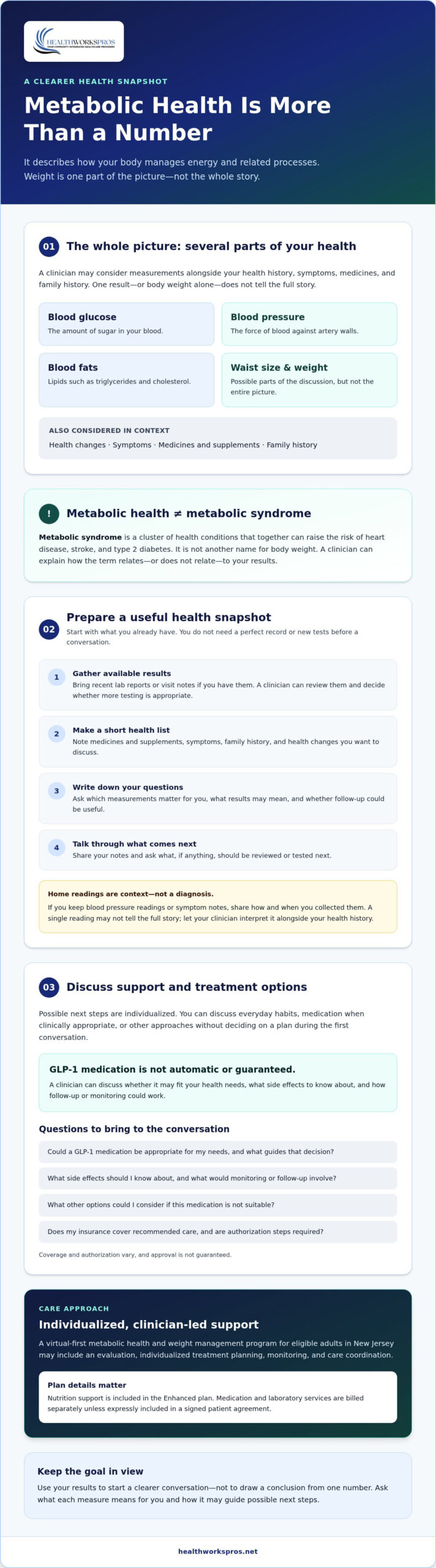
Metabolic health describes how your body manages energy and related processes, including blood sugar and blood fats. It is not captured by body weight alone. A clinician may consider your health history, symptoms, medicines, and relevant measurements together to understand what they mean for you.
Metabolic health is a picture made from several parts of your health, not a conclusion drawn from one measurement. Weight or waist size may be part of the discussion, but neither tells the whole story. A result outside a typical range also needs context. Your clinician can explain what it may mean alongside other information.
Which parts of health might a clinician discuss?
Depending on your needs, a clinician may ask about or review:
- Blood glucose, which reflects the amount of sugar in your blood
- Blood pressure, the force of blood against artery walls
- Blood lipids, such as triglycerides and cholesterol
- Other measures, symptoms, health changes, and family history that may help complete the picture
Not everyone needs the same tests. Your clinician can decide whether testing is useful based on your history and the questions you want to address. Ask what each test looks for and how the result might affect next steps.
You may also hear the term metabolic syndrome. It refers to a cluster of health conditions that together can raise the risk of heart disease, stroke, and type 2 diabetes. It is not another name for body weight. Understanding the term can help you ask clearer questions about your own results.
How to prepare a useful metabolic health snapshot
A little preparation can help you make better use of a clinician conversation. Start with what you already have. You do not need to order tests or create a perfect record before an appointment.
- Gather available results. Bring recent laboratory reports or visit notes if you have them. Your clinician can review existing results and decide whether any additional testing is appropriate.
- Write down questions. Ask which measurements matter for your circumstances, what your results may mean, and when follow-up could be useful.
- Arrange a clinician conversation. Share your notes and ask what, if anything, should be reviewed or tested next.
What information should you bring to a clinical conversation?
If available, bring existing lab results and a current medication list, including supplements. Add notes about symptoms, when they occur, and any health changes you have noticed. You might ask, “What do these results mean for me?” or “Would any follow-up help clarify the picture?” For background on care options, the National Heart, Lung, and Blood Institute explains treatment for metabolic syndrome. It may help you prepare questions without deciding on a plan in advance.
Home records, such as occasional blood pressure readings or notes about symptoms, can give your clinician useful context. They cannot diagnose a condition, and a single reading may not tell the full story. Share how and when you collected any measurements, and let your clinician interpret them alongside your health history.
For information about a clinician-led option for eligible New Jersey residents, explore the HWP Metabolic Health and Weight Management program.
How to discuss support and treatment options with a clinician
Ask what each option is intended to address, what follow-up may involve, and how progress will be monitored. A clinician can also explain how metabolism works and how that relates to your care. You can discuss lifestyle support, medication when clinically appropriate, or other approaches without committing to treatment during the first conversation.
Questions to ask about GLP-1 care, follow-up, and coverage
- Could a GLP-1 medication be appropriate for my health needs, and what factors guide that decision?
- What side effects should I know about, and how would monitoring or follow-up work?
- What other options could I consider if this medication is not suitable?
- Does my insurance plan cover any recommended care, and are authorization steps required?
Coverage and authorization vary, and approval is not guaranteed. Ask about potential next steps before making decisions. HWP Metabolic Health and Weight Management™ provides clinician-led care for eligible adults in New Jersey. Its virtual-first model may include a metabolic evaluation, individualized treatment planning, assessment of treatment options, monitoring, and care coordination. Monitoring may include weight, symptoms, vital signs, adherence, and adverse effects, according to clinical need. In-person evaluation or testing may also be needed. Nutrition support is included in the Enhanced plan.
Commercial insurance and self-pay pathways are available, but benefits and coverage vary by payer and plan. Medication and laboratory services are separate unless expressly included in a signed patient agreement. Review the HWP Metabolic Health and Weight Management program and ask which services and terms apply to your care.
Take a thoughtful next step for your health
Metabolic health is broader than body weight or a single test result. Your health history, symptoms, and relevant measures all help shape the picture. Gathering available results, noting medicines or changes, and preparing questions can make a clinician conversation more useful.
Care options should follow an individual evaluation, not an automatic path to medication. HWP Metabolic Health and Weight Management™ offers eligible New Jersey adults clinician-led evaluation and individualized planning, with monitoring and care coordination based on clinical need. In-person evaluation or testing may be needed.
If you are ready to explore support, contact HealthWorksPros to discuss your questions and possible next steps. Call or text 973-571-9090.
Frequently Asked Questions
What does metabolic health mean?
Metabolic health describes how well your body manages energy and related processes, including blood sugar, blood pressure, and blood fats. It is not defined by body weight alone. A clinician may consider these measures alongside your health history, symptoms, medicines, and other details. During an evaluation in New Jersey, ask how each result fits your overall health and whether follow-up may be useful.
Can you improve metabolic health without medication?
What tests are used to assess metabolic health?
Depending on your situation, a clinician may review blood glucose, blood pressure, and blood lipids such as cholesterol and triglycerides. They may also consider other measurements, your symptoms, and health history. There is not one test panel that everyone needs. Your clinician can explain why a test may be useful, whether existing results are enough, and what any findings could mean for next steps.
Is HWP Metabolic Health and Weight Management™ available virtually in New Jersey?
HWP Metabolic Health and Weight Management™ is available only to eligible New Jersey residents and uses a virtual-first care model. Evaluation, planning, monitoring, and care coordination may be provided virtually according to clinical need. Virtual care is not always suitable for every step. An in-person evaluation or testing may be needed. Contact HealthWorksPros to confirm current program availability and whether you may be eligible.

Article by
HealthWorksPros Clinical Editorial Team
This article was reviewed by the HealthWorksPros clinical and healthcare communications team. HealthWorksPros (HWP) is an integrated healthcare organization providing evidence-based primary care, behavioral health, psychiatry, counseling, occupational medicine, telehealth, and substance use treatment to individuals, families, employers, and communities throughout Northern New Jersey. Our content is created to educate and inform and is reviewed for medical accuracy using current clinical standards and trusted healthcare resources. While our articles provide general health information, they are not a substitute for personalized medical advice, diagnosis, or treatment. If you have questions about your health or need medical care, schedule an appointment with one of our healthcare providers.
Disclaimer
The information provided on this website is for general educational and informational purposes only and is not intended as medical advice, diagnosis, or treatment. Content is reviewed for accuracy at the time of publication but should not be considered a substitute for professional medical evaluation or personalized healthcare recommendations.
Always seek the advice of your physician or another qualified healthcare provider regarding any medical condition or before starting, stopping, or changing any treatment. Never disregard professional medical advice or delay seeking care because of information you have read on this website.
If you believe you are experiencing a medical emergency, call 911 or go to the nearest emergency department immediately.
Use of this website does not establish a physician-patient relationship with HealthWorksPros (HWP) or any of its providers. Appointment requests or communications submitted through this website do not guarantee the establishment of a provider-patient relationship until you have been evaluated and accepted for care in accordance with applicable laws and professional standards.