


The lower-cost choice isn’t automatically the right level of care. For severe symptoms that threaten life or limb, call 911 or go to an emergency room. Don’t delay emergency care to compare bills.
Cost concerns are real, and choosing where to go can be difficult when you already feel unwell. This guide explains urgent care vs emergency room costs, why bills vary by location, tests, and treatment, and what may affect the cost of an uninsured ER visit. It also outlines which symptoms generally fit urgent care and which need emergency care, so you can make an informed decision without compromising safety.
Key Takeaways
- Understand why an ER bill can change based on the care, tests, and treatment involved.
- Compare typical costs for urgent care and emergency care without relying on one figure to predict your bill.
- Use the seriousness of the symptoms, not cost alone, to guide where to seek care.
- Learn what billing estimates and financial assistance may mean when paying without insurance.
What is the average emergency room cost without insurance?
A visit involving imaging or emergency procedures may cost more than one requiring fewer services.
Insurance changes what a patient pays. The amount depends on the plan, deductible, copay, and whether the hospital is in network. After meeting the deductible, the patient’s share depends on the plan’s coverage and cost-sharing rules. Urgent care copays are often lower, but the plan determines the patient’s share.
| Care option | Typical payment pattern | Best suited for |
|---|---|---|
| Emergency room | Charges reflect hospital evaluation, tests, and treatment. | Severe or threatening conditions |
| Urgent care | Insurance copays depend on the plan; self-pay charges depend on care. | Prompt care for non-life-threatening concerns |
Hospital bills may include separate charges for the facility, evaluation, diagnostic tests, and treatment. The services provided help determine the total amount owed.
An ER bill may sometimes be reduced, but being discharged without admission does not automatically lower it. Patients can ask the hospital about financial assistance. The No Surprises Act limits patients’ out-of-pocket payments for surprise emergency room bills.
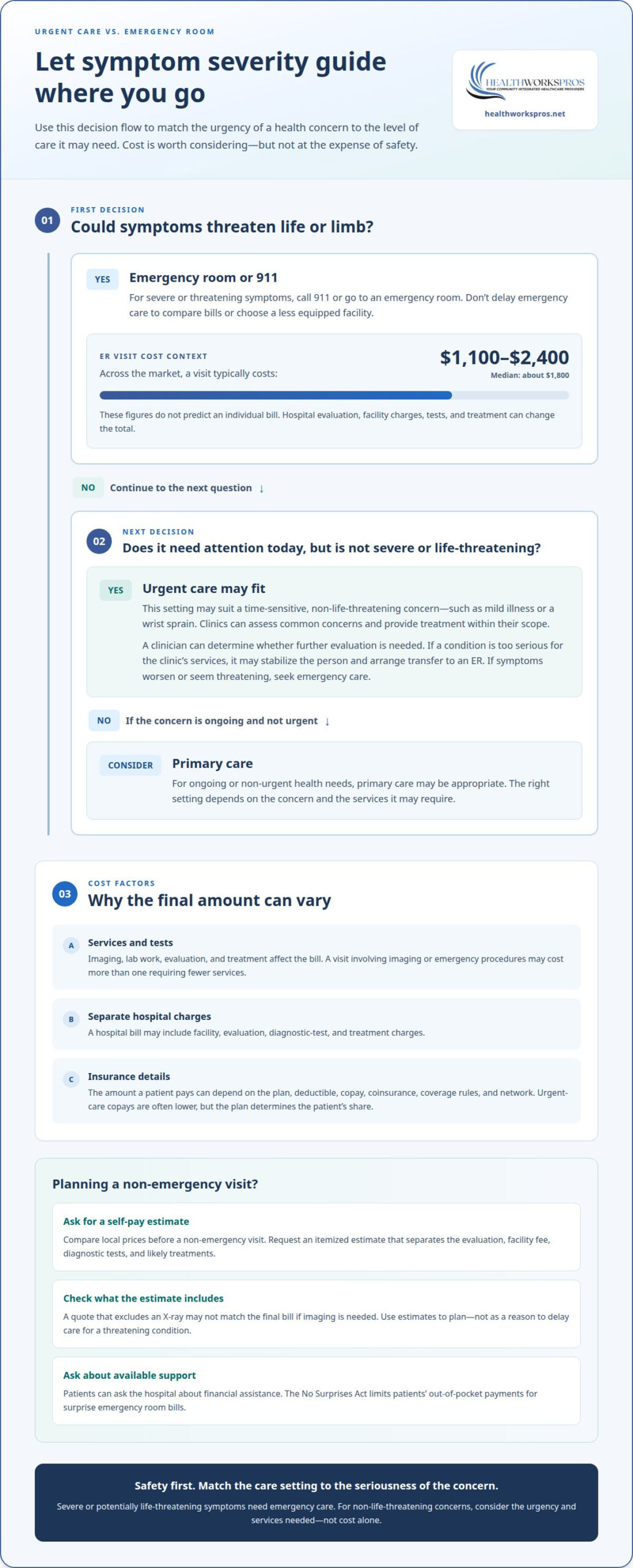
Choose emergency care for severe or threatening symptoms. Consider urgent care for a non-life-threatening concern that needs prompt attention.
When to choose urgent care?
Choose urgent care for an illness or injury that needs attention today but does not threaten life or limb. A wrist sprain or flu symptoms may fit this level of care. Urgent care clinics can assess common concerns and provide treatments within their scope. A clinician can also determine whether further evaluation is needed.
Go to the emergency room or call 911 for severe symptoms that may threaten life or limb. The ER is the appropriate setting for emergencies that need immediate attention. Don’t choose a less equipped facility simply because you expect it to be more affordable. Safety comes before comparing the average cost.
- Consider urgent care: symptoms are time-sensitive, but not severe or life-threatening, such as a mild illness or wrist sprain.
- Choose the ER: the condition appears severe or threatens life or limb, or needs emergency treatment.
Urgent care may suit a problem that can be assessed and treated without hospital-level emergency services. The right facility depends on your symptoms and the care they may require, not just the expected wait or bill. ER visits are prioritized by severity, so arriving later does not mean a less serious case will be seen first.
Facility fees and diagnostic needs can affect the cost of a visit. An urgent care clinic may stabilize someone whose condition is too serious for its services and arrange transfer to an ER. If symptoms worsen or seem threatening, seek emergency care rather than waiting for a clinic visit. Match the level of care to the concern instead of letting cost be the only deciding factor.
Average emergency room and urgent care costs
Across the market, an emergency room visit typically costs between $1,100 and $2,400, with a median of about $1,800. These figures show why the average alone may not predict what a patient pays. A hospital visit involving imaging, lab work, or treatment can cost more than an evaluation without those services.
Without insurance, urgent care charges also depend on the illness, examination, tests, and treatment. There is no reliable amount that applies to every clinic or visit. The difference between urgent care and emergency room costs reflects both the facility and the services provided, not just the type of clinician seen.
Patients can compare local prices by asking each facility for a self-pay estimate before a non-emergency visit. Request an itemized estimate that separates the evaluation, facility fee, diagnostic tests, and likely treatments. For example, a quote that excludes an X-ray may not match the final bill if imaging is needed.
If you have insurance, compare your plan’s urgent care copay with its ER copay, deductible, and coinsurance. Emergency care coverage and the amount you owe can vary by plan and network. Urgent care may be convenient for a non-life-threatening illness, while severe symptoms need emergency care regardless of the expected out-of-pocket cost.
Use an estimate as a planning tool, not as a reason to delay care for a threatening condition. For ongoing or non-urgent concerns, primary care may also be appropriate. The right choice depends on your symptoms and the services you need.
HealthWorksPros: Primary Care
HealthWorksPros offers Primary Care for people seeking support with ongoing health needs. If symptoms are severe or may threaten life or limb, call 911 or go to an emergency room instead. Choosing the right setting starts with the urgency and seriousness of the health concern, not cost alone.
For health needs that are not urgent, Primary Care may be a good fit for ongoing care. Consider whether your concern needs emergency treatment or continued medical care.
If you’re unsure which type of care fits your situation, describe your concern when contacting HealthWorksPros. For severe or life-threatening symptoms, seek emergency care immediately. Contact HealthWorksPros to learn more about its Primary Care services.
Choose care that supports your next step
A clear understanding of urgent care vs emergency room costs can inform your planning, but the seriousness of your symptoms should guide where you seek care. For severe or potentially life-threatening symptoms, seek emergency care right away. For non-emergency health needs, consider which type of care fits the concern and your next steps.
HealthWorksPros offers Primary Care for ongoing health needs. These services address different needs, so choosing care that fits your concern can help you move forward with greater clarity.
If you have questions about care options, reach out for information. For an emergency, call 911 or go to the nearest emergency room. Taking a thoughtful next step can make care feel more manageable.
You deserve care and guidance that respect your needs.
Frequently Asked Questions
What is the average cost and wait time of an ER visit?
ER costs and waits vary, and there is no single wait time that applies to every visit. Emergency departments assess patients by the severity of their condition, so a person who arrives later may be seen first. The final bill depends on the evaluation and services provided.
When should I seek emergency room care?
Seek emergency care when symptoms suggest a life- or limb-threatening problem or need immediate hospital-level attention. Call 911 for a serious emergency rather than driving yourself if that could put you at risk. If symptoms suddenly become severe while you are considering another care setting, prioritize emergency help over comparing facilities or estimating a bill.
What is the average cost of an urgent care visit in the U.S.?
The estimate may not cover every service or situation. The total can depend on the examination, diagnostic testing, and treatment provided. A visit requiring testing may cost differently from one that involves only an evaluation.
What is the average cost of an emergency room visit in the U.S.?
There is no single ER charge that applies to every U.S. visit. The hospital, reason for the visit, and care provided all affect the bill. Diagnostic imaging, lab work, and treatment can add charges. Treat a general estimate as a starting point, not a guaranteed final amount.
How much do urgent care and ER visits cost with insurance?
Your plan determines your share for either visit. Before a non-emergency appointment, review your summary of benefits for urgent care and ER cost-sharing, then check whether the facility is in network. After care, compare the hospital or clinic bill with your insurer’s explanation of benefits. The explanation shows how the claim was processed, but it is not itself a bill.

Article by
HealthWorksPros Clinical Editorial Team
This article was reviewed by the HealthWorksPros clinical and healthcare communications team. HealthWorksPros (HWP) is an integrated healthcare organization providing evidence-based primary care, behavioral health, psychiatry, counseling, occupational medicine, telehealth, and substance use treatment to individuals, families, employers, and communities throughout Northern New Jersey. Our content is created to educate and inform and is reviewed for medical accuracy using current clinical standards and trusted healthcare resources. While our articles provide general health information, they are not a substitute for personalized medical advice, diagnosis, or treatment. If you have questions about your health or need medical care, schedule an appointment with one of our healthcare providers.
Disclaimer
The information provided on this website is for general educational and informational purposes only and is not intended as medical advice, diagnosis, or treatment. Content is reviewed for accuracy at the time of publication but should not be considered a substitute for professional medical evaluation or personalized healthcare recommendations.
Always seek the advice of your physician or another qualified healthcare provider regarding any medical condition or before starting, stopping, or changing any treatment. Never disregard professional medical advice or delay seeking care because of information you have read on this website.
If you believe you are experiencing a medical emergency, call 911 or go to the nearest emergency department immediately.
Use of this website does not establish a physician-patient relationship with HealthWorksPros (HWP) or any of its providers. Appointment requests or communications submitted through this website do not guarantee the establishment of a provider-patient relationship until you have been evaluated and accepted for care in accordance with applicable laws and professional standards.