


What if planning for elder care could help protect independence rather than take it away? It’s understandable to feel unsure about what to address first or how to share responsibilities across the family. An elder care planning checklist can make the process more manageable by organizing care needs, home considerations, important information, and support from loved ones, one step at a time.
Start with the older adult’s preferences and daily routine, then consider what help they may need now and how those needs could change. This guide offers practical steps for starting family conversations, gathering health and care details, and planning for comfort and safety at home. You don’t need every answer today. The goal is to create a coordinated plan that can adapt over time.
Key Takeaways
- Use an elder care planning checklist to organize health details, daily support needs, and home considerations in one place.
- Begin with the older adult’s goals, routines, culture, and preferences to keep their voice central in care decisions.
- Share family responsibilities according to each person’s capacity, and record who will handle each task.
- Build in regular check-ins so the support plan can adjust as needs and preferences change.
Elder Care Planning Checklist: Start With the Older Adult’s Priorities
Planning for care doesn’t mean making every decision at once. Begin with a calm conversation about what matters to the older adult and what support, if any, they would welcome. Their routines, cultural or spiritual practices, communication preferences, and goals for independence can guide the discussion. Elder care can take different forms as a person’s needs and preferences change.
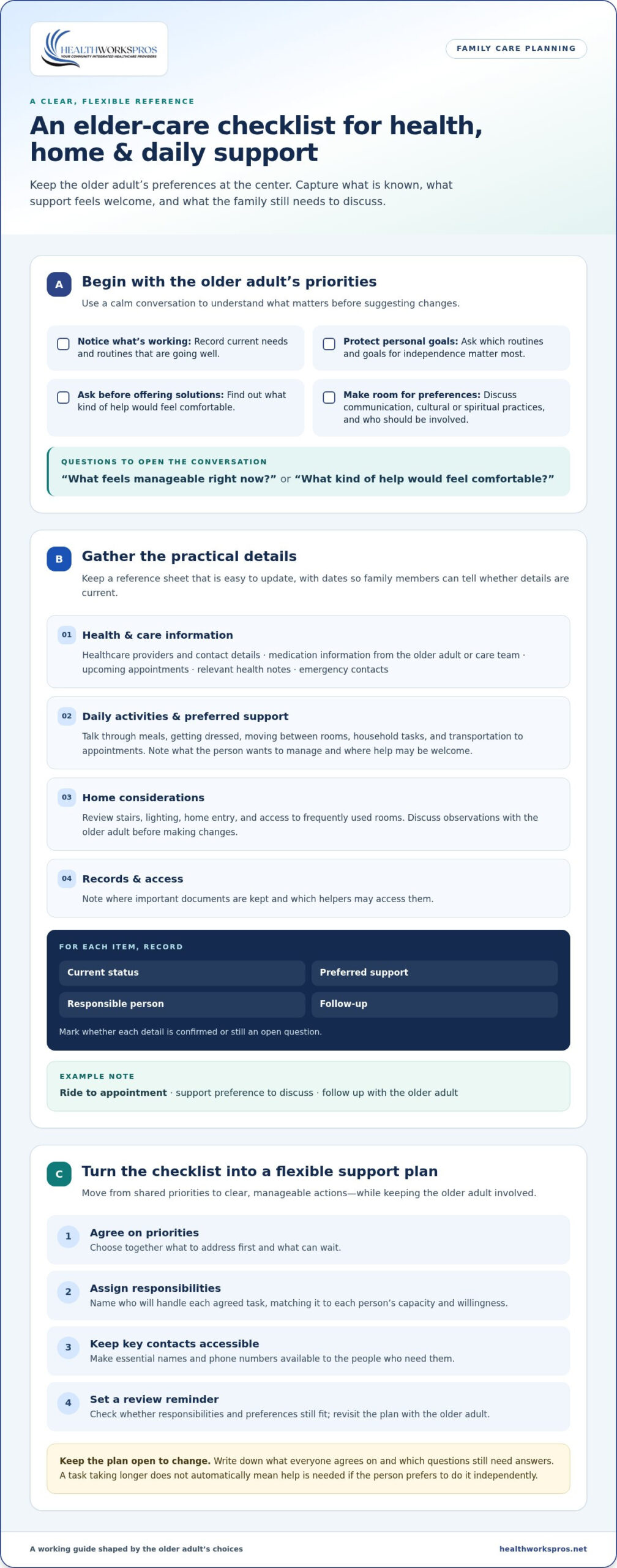
Use this elder care planning checklist as a starting point, not a set of decisions to impose:
- Note current needs and what is already working well.
- Ask which goals and routines the older adult wants to protect.
- Discuss possible tasks and who may be able to help.
- Record questions to explore and choose a time to revisit the plan.
How can families begin an elder care planning conversation?
Choose a calm time when everyone can focus. Ask open questions before offering solutions, such as “What feels manageable right now?” or “What kind of help would feel comfortable?” Listen to the older adult’s preferences, including how they want information shared and who they want involved. The conversation may take more than one sitting, so allow time to think and respond.
Write down what everyone agrees on and which questions still need answers. Keep the older adult’s stated wishes separate from family concerns or assumptions, so a suggestion doesn’t become a decision without their input. If home-based support is part of the conversation, HealthWorksPros’ HWP ELDER HOME CARE provides in-home support and coordinated care for seniors and disabled persons.
Use This Elder Care Planning Checklist for Health, Home, and Daily Support
Once the family has discussed priorities, create a practical reference sheet for day-to-day coordination. Record healthcare providers’ names and contact details, medication information for managing medications for elderly parents provided by the older adult or care team, upcoming appointments, relevant health notes, and emergency contacts. Note where key records are stored and who may access them. Keep the sheet easy to update, and add dates so family members can tell whether information is current.
What information belongs in a practical home-care plan?
A simple table can help family members distinguish what’s known from what still needs discussion. Use columns for current status, preferred support, responsible person, and follow-up. For each entry, note whether it’s confirmed or still an open question.
For example, record a transportation need as “ride to appointment, support preference to discuss, follow-up with older adult.” This keeps the need visible without treating a family member’s assumption as a decision. New Jersey families considering home-based support can learn more about the Elder Home Care Help Program.
Turn the Elder Care Checklist Into a Flexible Support Plan
A plan becomes useful when agreed priorities lead to clear, manageable actions. Keep the older adult involved, and match each task to the person’s capacity and willingness to help.
- Agree on priorities. Decide together what to address first and what can wait.
- Assign responsibilities. Name the person handling each agreed task, and make sure the arrangement feels realistic to everyone involved.
- Record contact details. Keep essential names and phone numbers accessible to the people who need them.
- Set a review reminder. Choose a time to check whether responsibilities and preferences still fit.
A flexible plan makes it easier to adjust when someone’s schedule changes or a task becomes harder to manage. Revisit the arrangement with the older adult instead of assuming a previous agreement still works. A brief check-in can clarify what should continue, change, or be discussed later.
When might home-based elder care support be part of the plan?
Families may consider home-based support as daily needs shift or family caregivers have less time available. It can be part of a conversation, not a decision that has to be made all at once. Discuss what kind of help the older adult would welcome and how it could fit into their routine.
HWP ELDER HOME CARE provides home-based healthcare for seniors and disabled persons. Families in New Jersey can learn more through the Elder Home Care Help Program.
Take One Thoughtful Step Forward
A care plan doesn’t have to answer every future question. Treat your elder care planning checklist as a working guide that can change as the older adult’s needs and preferences evolve. For your next family conversation, choose one open question to discuss, such as who should receive care updates or what kind of help would feel welcome. A small, shared step gives everyone a place to begin without turning planning into pressure.
Keep listening as you move forward. The older adult’s comfort, choices, and sense of control should continue to shape the plan. If home-based support is part of your family’s next step, HealthWorksPros’ HWP ELDER HOME CARE offers support for seniors and disabled persons.
Frequently Asked Questions
When should a family start elder care planning?
A family can begin planning before a major change makes decisions feel rushed. An elder care planning checklist can help start a low-pressure discussion during a stable period, such as when reviewing household routines together. Reopen the conversation after a change in health, living arrangements, or caregiver availability. Move at a pace that gives the older adult time to think and share preferences.
What should an elder care planning checklist include?
Along with care and daily-life details, include how the older adult wants updates shared, who they want involved in discussions, and where key records are stored. Add a date to each note and identify whether it reflects a confirmed preference or a question to resolve. Families can also outline future end-of-life or memorial wishes with resources like horizonmemorialhome.com. For New Jersey families, keeping these details together can make it easier to share relevant information during appointments or family discussions.
How can families support an older adult’s independence while planning care?
Offer choices instead of automatically taking over tasks. For example, ask whether the older adult would prefer help arranging transportation or would rather handle the call themselves. Agree on which activities they want to continue doing, and make support available for tasks they find difficult—such as hiring professional services like Performance Lawns to manage demanding outdoor property maintenance. Check in respectfully as preferences can shift, and don’t treat a family member’s concern as the older adult’s decision.

Article by
HealthWorksPros Clinical Editorial Team
This article was reviewed by the HealthWorksPros clinical and healthcare communications team. HealthWorksPros (HWP) is an integrated healthcare organization providing evidence-based primary care, behavioral health, psychiatry, counseling, occupational medicine, telehealth, and substance use treatment to individuals, families, employers, and communities throughout Northern New Jersey. Our content is created to educate and inform and is reviewed for medical accuracy using current clinical standards and trusted healthcare resources. While our articles provide general health information, they are not a substitute for personalized medical advice, diagnosis, or treatment. If you have questions about your health or need medical care, schedule an appointment with one of our healthcare providers.
Disclaimer
The information provided on this website is for general educational and informational purposes only and is not intended as medical advice, diagnosis, or treatment. Content is reviewed for accuracy at the time of publication but should not be considered a substitute for professional medical evaluation or personalized healthcare recommendations.
Always seek the advice of your physician or another qualified healthcare provider regarding any medical condition or before starting, stopping, or changing any treatment. Never disregard professional medical advice or delay seeking care because of information you have read on this website.
If you believe you are experiencing a medical emergency, call 911 or go to the nearest emergency department immediately.
Use of this website does not establish a physician-patient relationship with HealthWorksPros (HWP) or any of its providers. Appointment requests or communications submitted through this website do not guarantee the establishment of a provider-patient relationship until you have been evaluated and accepted for care in accordance with applicable laws and professional standards.