


What if changing doctors didn’t mean starting your care over? It’s understandable to wonder what to tell your current doctor, how to transfer medical records and prescriptions, or whether a new provider is covered by your insurance. Knowing how to switch primary care doctors can help you plan the change and reduce the chance of gaps in care.
A smooth switch is a planned handoff, not just a new appointment. Start by reviewing your health plan’s rules, arranging to transfer important records, and listing ongoing care needs. Then prepare questions for your first visit. These steps can help your new primary care team understand your health history and priorities from the start.
Key Takeaways
- Consider a change when your care, communication, access, or practical needs no longer fit, and identify what you want from a new doctor.
- Learning how to switch primary care doctors starts with reviewing your health plan’s rules and using its current directory or member support.
- Plan the handoff by gathering key health information and arranging a first visit to discuss ongoing care needs.
- Use your first appointment to share priorities and ask questions. HealthWorksPros provides primary care in New Jersey.
When should you switch primary care doctors, and what should you consider first?
You can consider changing primary care doctors when the care, communication, access, or practical arrangements no longer fit your needs. A move within or beyond Essex County, a change in your health needs, or difficulty communicating comfortably may prompt you to reassess. You don’t need to prove that your current clinician did something wrong. Your healthcare needs and preferences can change over time.
Primary care can involve more than addressing an immediate concern. A primary care physician can help with a range of health needs and coordinate care. For a general overview, see Understanding the Role of a Primary Care Physician.
How do you know when a new primary care doctor may be a better fit?
Think about how visits feel and whether practical access works for you. Do you feel listened to and treated with respect? Can you discuss concerns in a language and style that feel comfortable? Do scheduling, location, or other day-to-day details make it hard to get care? One concern alone may not settle the decision, but noticing a pattern can help clarify what you want to change.
Before taking the next steps in how to switch primary care doctors, write down the care priorities that matter most to you. For example:
- Clear explanations and time to ask questions
- Communication that feels comfortable and respectful
- Support for ongoing health needs or coordination with other clinicians
- A location or appointment process that fits your routine
This list can guide your decision. You don’t have to share private reasons for changing doctors broadly. If you decide to make a change, keep any explanation brief and focus on the practical steps needed to continue your care.
How to switch primary care doctors and keep care on track
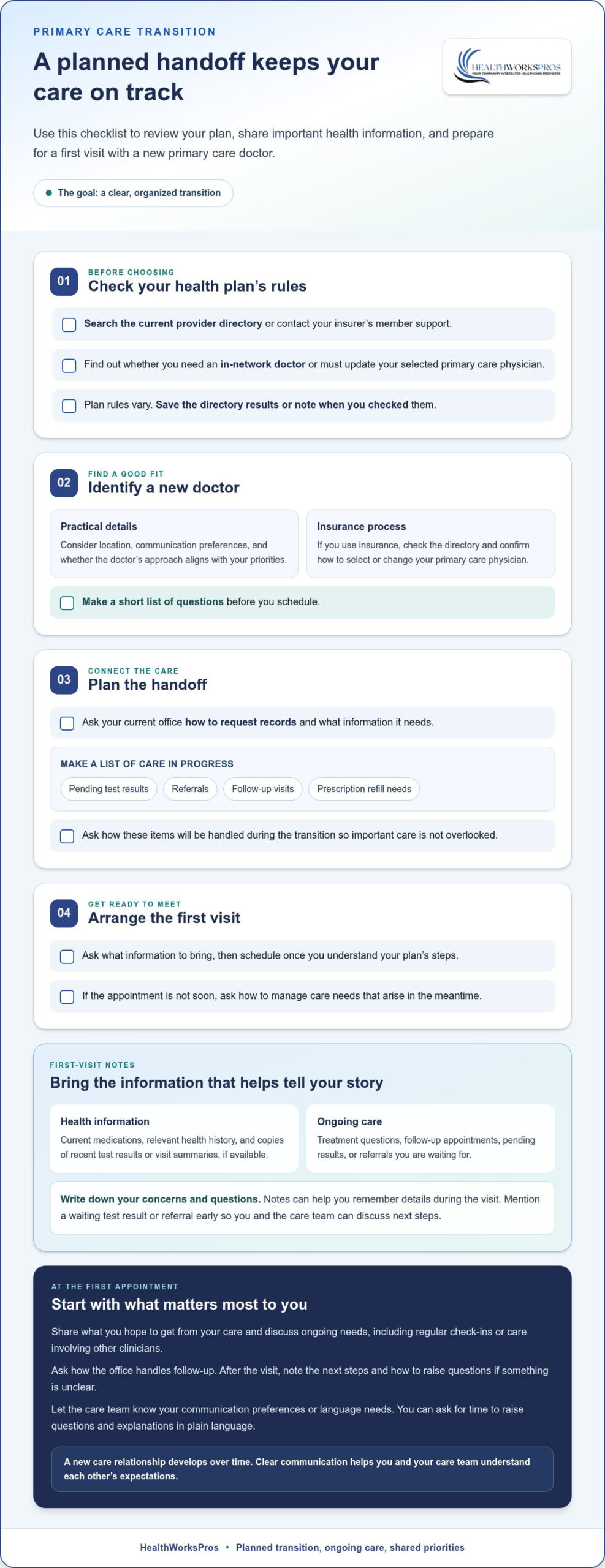
A planned handoff can make changing doctors easier to manage. Follow these steps to understand your plan’s requirements, share useful health information, and prepare for your first visit.
- Review your health plan’s rules. Use your insurer’s current provider directory or contact member support to learn whether you need an in-network doctor or must update your selected primary care physician. Plan rules vary, so review your own coverage before arranging care. Save the directory results or note the date you checked them.
- Identify a new doctor. Compare practical details such as location, communication preferences, and whether the doctor’s approach seems aligned with your priorities. For example, outpatient primary care services like ecto.com.my emphasize accessible medical consultations and patient-centered communication. If you use insurance, check the provider directory and confirm the plan’s process for selecting or changing a primary care physician. Make a short list of questions before you schedule.
- Plan the handoff. Ask your current office how to request records and what information it needs. Make a list of pending test results, referrals, follow-up visits, and prescription refill needs. Ask how these will be handled during the transition so nothing important is overlooked.
- Arrange the first visit. Once you understand your plan’s steps, schedule a visit and ask what information to bring. Keep notes on your health history, current care, and questions you want to discuss. If the appointment is not soon, ask how to manage any care needs that arise in the meantime.
What should you prepare before your first appointment?
Bring or make a list of your current medications, relevant health history, and concerns you want to address. Include questions about ongoing treatment, follow-up appointments, or pending care. If you’re waiting for a test result or referral, mention it early so you and the new care team can discuss next steps. Written notes can help if you don’t remember every detail. If you have copies of recent test results or visit summaries, bring them as well.
These steps make how to switch primary care doctors a more organized process while leaving room for your new clinician to learn what matters to you. If you’re exploring primary care in Northern New Jersey, you can connect with HealthWorksPros about primary care.
What to expect after changing doctors, and how HealthWorksPros can support your next step
Your first visit with a new primary care doctor is a chance to start building a working relationship. Explain what you hope to get from your care, ask how the office handles follow-up, and discuss ongoing needs such as regular check-ins or care involving other clinicians. If you’re unsure where to begin, share your main concern first and bring up other questions as the visit allows.
After the visit, note the next steps you discussed, such as follow-up appointments or information the care team needs. If something wasn’t clear, ask how to raise the question. A new relationship develops over time, and clear communication can help you and your care team understand each other’s expectations.
How can you build a comfortable relationship with a new primary care doctor?
Let the care team know how you prefer to communicate and whether you have language needs or other preferences that would help you feel at ease. You can explain what matters most, such as having time to ask questions or receiving explanations in plain language. HealthWorksPros provides bilingual English- and Spanish-language care. Sharing your needs can help guide conversations as you establish care.
HealthWorksPros provides primary care in Northern New Jersey, including Clifton and East Orange. You can use the primary care inquiry form to get in touch about taking a next step. A thoughtful transition is not only about selecting a new doctor. It is also about making space for your priorities and ongoing care needs to be heard.
Take the next step toward care that fits
Changing doctors can open the door to a care relationship that better reflects your needs and preferences. As you consider how to switch primary care doctors, give yourself room to ask questions, share what matters to you, and decide what kind of communication helps you feel involved in your care. You don’t need to have every detail figured out before taking a first step.
HealthWorksPros provides patient-centered primary care in Northern New Jersey. A first conversation can help you discuss your health needs and the kind of care you’re looking for, without pressure to make decisions before you’re ready.
To take the next step, contact HealthWorksPros about primary care in New Jersey.
Frequently Asked Questions
Can I switch primary care doctors at any time?
Often, yes, but the steps depend on your coverage. Original Medicare generally lets you see another doctor who accepts Medicare. NJ FamilyCare members can request a PCP change through their plan, and the change may take time to become effective. Medicare Advantage plan changes follow enrollment periods, which are different from changing the doctor within your current plan.
Do I need to tell my current primary care doctor that I am switching?
No, you generally don’t need to explain your decision before seeing a new doctor. If you choose to tell your current office, you can keep the message brief and share only what you’re comfortable sharing. A change in personal circumstances or preferences is enough. You don’t need to criticize your clinician or provide private details.
How do I transfer my medical records to a new primary care doctor?
Ask the former office how to submit a records request and whether it needs a signed form. Under HIPAA, providers generally must respond to a patient’s access request within 30 calendar days. In New Jersey, the fee for patient copies is capped at $1 per page or $50 for the entire record, whichever is less.
Will switching primary care doctors affect my insurance coverage?
Changing doctors alone doesn’t usually change your insurance policy or benefits. Changing your insurance plan is a separate decision and may have enrollment limits, especially for Medicare Advantage coverage. Your costs for a visit can still depend on your plan’s network and coverage terms, so changing doctors doesn’t by itself confirm that a specific visit will be covered.

Article by
HealthWorksPros Clinical Editorial Team
This article was reviewed by the HealthWorksPros clinical and healthcare communications team. HealthWorksPros (HWP) is an integrated healthcare organization providing evidence-based primary care, behavioral health, psychiatry, counseling, occupational medicine, telehealth, and substance use treatment to individuals, families, employers, and communities throughout Northern New Jersey. Our content is created to educate and inform and is reviewed for medical accuracy using current clinical standards and trusted healthcare resources. While our articles provide general health information, they are not a substitute for personalized medical advice, diagnosis, or treatment. If you have questions about your health or need medical care, schedule an appointment with one of our healthcare providers.
Disclaimer
The information provided on this website is for general educational and informational purposes only and is not intended as medical advice, diagnosis, or treatment. Content is reviewed for accuracy at the time of publication but should not be considered a substitute for professional medical evaluation or personalized healthcare recommendations.
Always seek the advice of your physician or another qualified healthcare provider regarding any medical condition or before starting, stopping, or changing any treatment. Never disregard professional medical advice or delay seeking care because of information you have read on this website.
If you believe you are experiencing a medical emergency, call 911 or go to the nearest emergency department immediately.
Use of this website does not establish a physician-patient relationship with HealthWorksPros (HWP) or any of its providers. Appointment requests or communications submitted through this website do not guarantee the establishment of a provider-patient relationship until you have been evaluated and accepted for care in accordance with applicable laws and professional standards.